


📌 Executive Summary & Key Takeaways
- IB Physics Rigor: Covers Standard Level (SL) and Higher Level (HL) across Space, Time & Motion, Thermal Physics, Waves, Electricity & Magnetism, and Quantum Physics.
- New Syllabus Focus: The updated IB Physics curriculum emphasizes conceptual link-building, experimental methodology, data analysis, and integrated paper structures.
- Internal Assessment (IA): Securing top marks on the 3,000-word Scientific Investigation (IA) provides a crucial 20% cushion toward a final Grade 7 score.
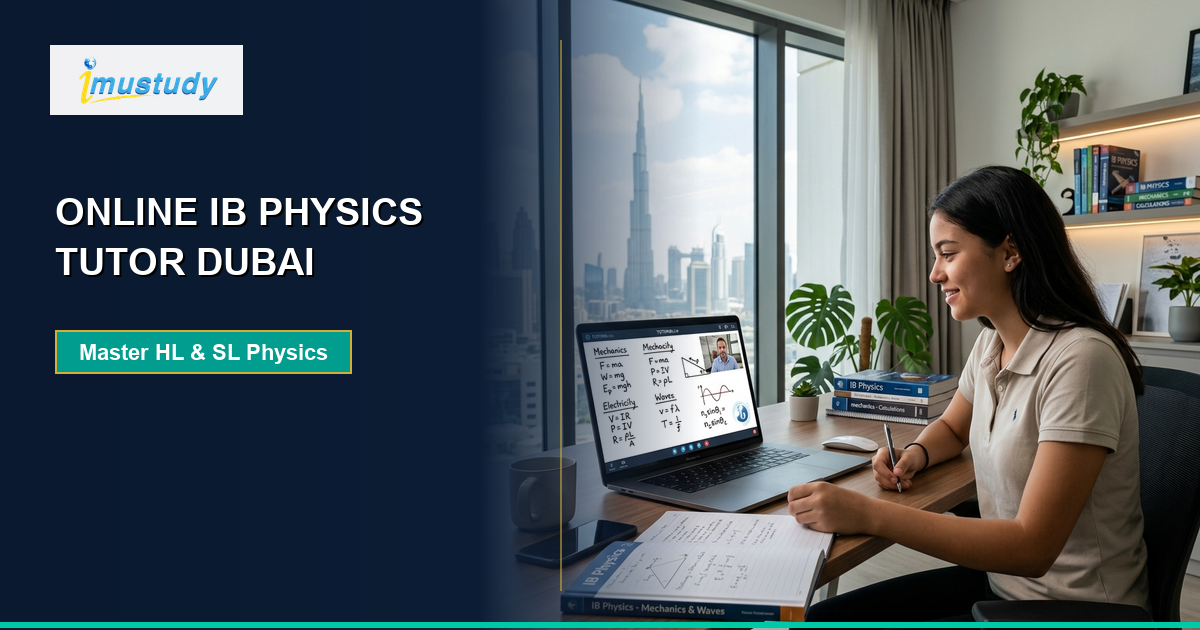
- 1-on-1 Online Tutoring in Dubai: Personalized instruction with experienced IB examiners to master calculation questions, vector motion, and data booklet applications.
Conquering IB Physics (HL & SL) in Dubai: Your Path to Grade 7
The International Baccalaureate (IB) Diploma Programme Physics course is universally recognized as one of the most demanding high school science qualifications in existence. Whether taking SL or HL, students must master complex physics principles while developing advanced mathematical skills in calculus, vector algebra, and graphical analysis.
For students attending international schools across Dubai, Abu Dhabi, and globally, working with an experienced online IB Physics tutor provides the individual support required to transform difficult concepts into exam success.
What score is needed to get a Grade 7 in IB Physics HL?
Grade boundaries for IB Physics HL vary per exam session, but generally a overall mark of 68% to 75% is required for a Grade 7. Success requires performing well on Paper 1 (Multiple Choice & Data-based questions), Paper 2 (Extended Response), and obtaining 18+/24 on the Internal Assessment (IA).
IB Physics Syllabus Overview: SL vs. HL Requirements
| Syllabus Theme | Standard Level (SL) Core | Higher Level (HL) Additional Content |
|---|---|---|
| Theme A: Space, Time & Motion | Kinematics, Newton’s Laws, Momentum, Work & Energy | Rigid Body Rotation, Torque, Angular Momentum |
| Theme B: Thermal Physics | Thermal concepts, Gas laws, Ideal gas model | Thermodynamic cycles, Entropy, Heat Engines |
| Theme C: Wave Behaviour | SHM, Wave motion, Standing waves, Interference | Single-slit diffraction, Rayleigh criterion, Doppler Effect |
| Theme D: Fields & Electricity | Electric/Gravitational fields, Electric circuits, Resistance | Electromagnetic Induction, Faraday’s & Lenz’s Laws |
| Theme E: Quantum & Nuclear | Atomic energy levels, Radioactivity, Mass defect | Photoelectric Effect, Wave functions, Quantum tunneling |
Worked Exam Example: Electromagnetic Induction (HL Paper 2 Style)
Problem: A rectangular wire loop of area \(A = 0.05 \, ext{m}^2\) with \(N = 100\) turns is pulled out of a uniform magnetic field \(B = 0.40 \, ext{T}\) in time \(\Delta t = 0.20 \, ext{s}\). Calculate the magnitude of the induced electromotive force (emf).
Solution by iMustudy Tutor:
- Recall Faraday’s Law of Induction: \(\mathcal{E} = -N rac{\Delta \Phi}{\Delta t}\), where \(\Phi = B imes A\).
- Calculate initial magnetic flux: \(\Phi_i = B \cdot A = 0.40 imes 0.05 = 0.02 \, ext{Wb}\).
- Calculate final magnetic flux: \(\Phi_f = 0 \, ext{Wb}\) (since loop is completely removed from field).
- Apply formula:
\(\mathcal{E} = N rac{|\Delta \Phi|}{\Delta t} = 100 imes rac{0.02}{0.20} = 100 imes 0.10 = 10 \, ext{V}\).
Exam Tip: Always state SI units (\( ext{V}\) for Volts, \( ext{Wb}\) for Webbers) to avoid losing precision marks on Paper 2!
Targeting a Grade 7 in IB Physics HL or SL?
Receive expert 1-on-1 guidance from top IB Physics examiners and specialists at iMustudy.
Frequently Asked Questions (FAQ)
1. How does iMustudy assist with the IB Physics Internal Assessment (IA)?
Our expert IB tutors guide students through research question selection, experimental design, uncertainty propagation, data visualization, and drafting to help secure top marks (18–24/24).
2. What is the best way to revise for IB Physics Paper 1 MCQs?
Practice past Paper 1 questions topic by topic under strict timed conditions (1.5 minutes per question), focusing on fast estimation without a calculator.