


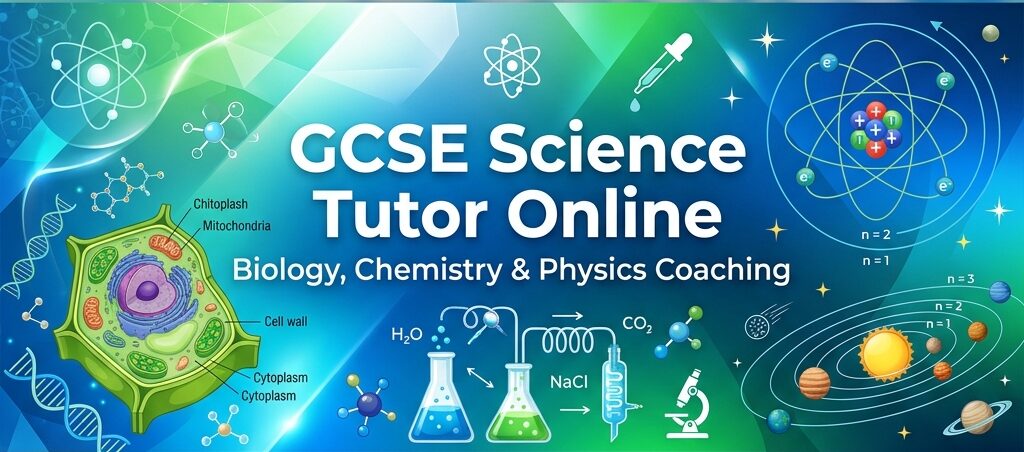

GCSE Science is a core component of the secondary school curriculum in the UK and international British schools worldwide. Taken either as Double Science (combining Biology, Chemistry, and Physics into two GCSE grades) or Triple Science (yielding three distinct GCSE grades), it represents a massive volume of factual content, mathematical equations, and laboratory analysis. Many students struggle to balance the distinct demands of the three sciences alongside their other subjects. Working with a specialized private gcse science tutor online provides the structured, personalized 1-on-1 support and exam strategies necessary to master the syllabus and excel on exam day.
Online tutoring provides students with access to highly experienced science educators. Let us explore the differences between Double and Triple science, the core units across Biology, Chemistry, and Physics, and why iMustudy is the premier GCSE science tuition provider.
GCSE Science covers a vast amount of material across three distinct disciplines. An online GCSE science tutor provides personalized 1-on-1 lessons to clarify cell biology, chemical bonding, and physics equations, guides you through exam-board specific past papers (AQA, Edexcel, OCR), and teaches you how to structure your workings to secure maximum method marks.
Understanding the GCSE Science Systems: Double vs. Triple Science
Double Science (Combined Science) covers the core concepts of Biology, Chemistry, and Physics and awards two GCSE grades. Triple Science (Separate Sciences) covers additional advanced topics in each subject and awards three distinct GCSE grades, which is highly recommended if you plan to take science at A-Level.
| Science Subject | Core Chapter Topics Covered | Mathematical Requirements | Importance for A-Level |
|---|---|---|---|
| GCSE Biology | Cell biology, transport systems, health & disease, photosynthesis, genetics, ecology | Basic percentages, magnification calculations, and graph interpretation. | Grade 7+ required to take A-Level Biology. |
| GCSE Chemistry | Atomic structure, bonding, quantitative chemistry, chemical changes, organic chemistry | Significant math component: moles, stoichiometry, and balancing equations. | Grade 7+ required to take A-Level Chemistry. |
| GCSE Physics | Energy, electricity, particle model, radioactivity, forces, waves, electromagnetism | Heavy math component: memorizing and applying over 20 physics equations. | Grade 7+ required to take A-Level Physics. |
Why Choose iMustudy for GCSE Science Prep
At iMustudy, we are committed to helping students achieve their academic potential. Our online GCSE science tutoring program provides:
- Expert Science Instructors: Our tutors are subject matter experts, many of whom have years of teaching experience in UK schools and serve as examiners.
- Live, Interactive 1-on-1 Classes: We do not offer recorded lectures. All classes are live, interactive, and customized to the student’s learning pace.
- Exam Board-Specific Preparation: Tutors specialize in the specific demands of AQA, Edexcel, and OCR, providing targeted practice on past paper questions.
- Comprehensive STEM Support: Excel in all your courses. We offer expert support across academic systems, including GCSE Maths Tutoring in the UK, and comprehensive College Admissions support.
Key Takeaways: Excelling in GCSE Science
- Learn Your Equations: For Physics, you must memorize and know how to rearrange dozens of equations. Practice this regularly.
- Understand the Chemistry Moles: Master the mole concept in Chemistry, which is the foundation of quantitative calculations.
- Show Your Working: Graders award up to 60% of marks for method. Always show every step of your calculation.
- Start Revision Early: Complete your syllabus early to allow 3-4 months of solid revision before the exams in May/June.
Frequently Asked Questions
1. What is the difference between Double and Triple Science?
Double Science (Combined Science) covers the core concepts of Biology, Chemistry, and Physics and awards two GCSE grades. Triple Science (Separate Sciences) covers additional advanced topics in each subject and awards three distinct GCSE grades, which is highly recommended if you plan to take science at A-Level.
2. Is GCSE Chemistry harder than GCSE Physics?
GCSE Chemistry focuses on molecular bonding, organic chemical groups, and mole calculations. GCSE Physics is heavily equation-based and covers energy transfers, electromagnetism, and radioactivity. Which is harder depends on whether your strengths lie in conceptual analysis or mathematical problem-solving.
3. How do online science lessons work at iMustudy?
Classes are held live on our interactive digital platform. Tutors and students use interactive whiteboards, screensharing, and shared document editors. All notes, worksheets, and session recordings are saved in the student’s portal for easy revision.